Beyond logo

United Kingdom Market Outlook: Price-Led Growth, Pacing-Driven Risk

Beyond logo with vacation rental image
In 2025, the UK market delivered strong revenue growth driven primarily by pricing rather than occupancy. Average Daily Rate (ADR) increased by 25% year on year, lifting RevPAN by 31%, while occupancy remained broadly stable at around 51%, confirming solid price tolerance, particularly during peak periods.

Looking ahead, the 2026 figures should be interpreted as forward booking pace rather than a realised forecast. While calendar ADRs are higher, forward occupancy remains low (around 10%), meaning outcomes will be highly dependent on how demand materialises over the coming booking window. As a result, clear pacing visibility and timely pricing action will be critical to protecting revenue.

Key Annual Metrics

(Market Averages)
Year
Occupancy %
ADR €
RevPAN €
Booking Lead Time
Length of Stay
2024
51.3%
166€
78€
32 Days
6 Days
2025
51.4%
208€
102€
29 Days
6 Days
2026 Current Projection
10% (current forward booked pacing)
+15% vs 2025
23€ (pacing)
7-30 Days
6 Days

2026 Outlook: Upside vs. Pacing Risk

Hot Markets in 2025

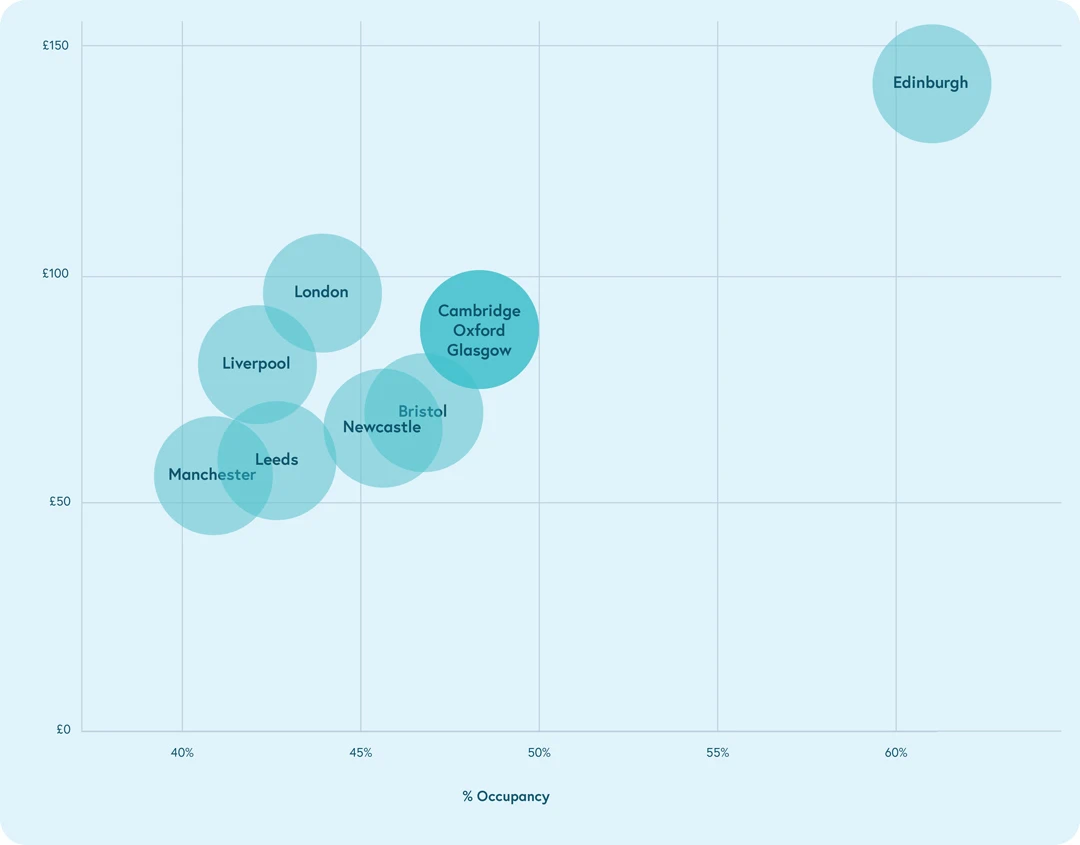
While there were a number of hot markets across the UK, as illustrated in the chart above, Beyond chose to take a deeper look at three markets with the potential for particularly interesting growth. To learn more about what Beyond’s data shows for your specific market, contact us here.
London, England

London

Key takeaway: London’s early-2026 pacing is stable on occupancy but softer on price. Revenue underperformance is rate-led, not demand-led. Weekly booking volumes are significantly lower than last year, while median booking lead times are notably longer.

What Beyond's Data Shows:

  • ADR is pacing below last year, particularly from March through July. The gap widens into early summer, indicating softer pricing power at current lead times.
  • Occupancy is broadly in line with last year, with only marginal differences month over month. January starts slightly ahead, and from February onwards, occupancy tracks very closely to 2025 levels.
  • RevPAN is slightly lower year over year, driven primarily by weaker ADR rather than occupancy losses. Demand is present, but guests are booking at lower rates.
  • Market-level context:
  • London’s weekly booking volumes are approximately 50% lower than last year. Median booking lead time has lengthened to around 80 days, indicating that bookings are being made further in advance but in much lower volumes.
  • Many listings are priced in the premium range, while overall market occupancy remains well below historical norms.

Recommended Actions:

  • Run a Booking Review to receive tailored base and minimum price recommendations for listings that are currently underperforming.
  • Adopt a two-pronged pricing approach: early-bird offers to capture long-lead demand (60–90 days), combined with targeted last-minute discounts (0–14 days) to fill low-occupancy nights.
  • Reduce conversion friction: shorten minimum stay requirements on low-occupancy weekdays, review cleaning and service fees, and test modest price adjustments (5–15%) on underperforming date ranges.
Edinburgh, England

Edinburgh

Key Takeaway: Despite a sharp rise in ADR from January to April 2026, occupancy fell markedly after January and remained weak through April. As a result, RevPAN is underperforming compared with the same period in 2025 - particularly from February onwards. Higher prices were not matched by booking pace, leading to a missed revenue opportunity.

What Beyond's Data Shows:

  • ADR is pacing below last year across most months, particularly from April through June, indicating reduced pricing power at current lead times.
  • Occupancy is broadly stable year over year, with January slightly ahead and February-April tracking closely to 2025. From May onward, occupancy softens marginally but remains within a normal seasonal range.
  • RevPAN is materially higher than last year, driven by steadier occupancy and improved revenue efficiency rather than aggressive rate growth.
  • The market appears demand-resilient but price-sensitive, favouring competitive pricing over premium positioning outside of peak festival periods.

Recommended Actions:

  • Re-align pricing with near-term demand over the next 7-21 days, and track booking pace daily to assess impact.
  • Temporarily relax minimum stay requirements, particularly midweek; add clearly visible last-minute discounts on OTA channels and promote flexible cancellation for early-2026 dates to improve conversion.
  • Monitor demand drivers and traffic, especially events in March-April (e.g. the Guinness Six Nations, conferences, festivals, Easter). If event support is limited, maintain a more aggressive pricing and promotional stance until demand strengthens.
  • Analyse your portfolio’s actual booking lead times and length of stay against market medians (LoS: 4.4 days; booking lead time: 23 days).
Manchester, England

Manchester

Manchester’s early-2026 pacing is under pressure. Both price and volume are softer, making near-term conversion and pricing discipline critical.

What Beyond's Data Shows:

  • ADR is pacing meaningfully below last year, especially from May through July. The gap widens into early summer, signalling increased price sensitivity and competitive pressure.
  • Occupancy declined sharply, falling to low single-digit levels by March–April, well below 2025 levels.
  • RevPAN is lower year over year across most months, driven by the combined effect of softer occupancy and lower ADRs. Revenue pressure is most visible from April onwards.
  • Market data indicates longer booking lead times among bookings that did convert, suggesting that demand exists but is highly price-sensitive at current rates.

Recommended Actions:

  • Re-align pricing with near-term demand. For February-April, track booking pace and pickup weekly to validate impact before scaling.
  • Apply targeted distribution levers: shorten minimum stay requirements, enable targeted OTA promotions, and add clearly visible last-minute discounts to improve conversion for short-lead bookings.
  • Use pacing-led triggers to act early: if booking pace remains more than 20-30% below last year after 7-14 days, expand price corrections or promotional activity to prevent further revenue loss.
  • Confirm demand drivers: review local events (e.g. spring half-term holidays) or potential travel disruptions (transport strikes, festival cancellations) that could be contributing to weak booking pace.

Seasonality & Pacing Signals

  • Peak season remains July - August, with strong pricing power.
  • Winter months show higher ADR but materially lower occupancy, indicating greater price sensitivity off-peak.
  • Jan-Apr 2026 pacing is weak, with single-digit to low double-digit booked occupancy. While UK lead times are typically short, this level warrants close monitoring.
  • Pricing ahead of the February half-term break is critical for conversion. The current gap between elevated posted prices and weak booking pace points to a price-sensitivity mismatch in family demand, rather than a lack of underlying travel intent.

How to Get Ahead in 2026

No Matter Your Market
  • Actively monitor the 2026 booking pace over the next 30 days. If bookings remain below last year’s levels, deploy targeted January–March incentives (last-minute discounts and lead-time promotions).
  • Protect peak-season pricing. Maintain higher ADRs for July–August and use minimum stay controls to maximise revenue per booking rather than discounting.
  • Defend winter occupancy tactically. Promote midweek and shoulder dates with lighter minimum stay requirements and modest price adjustments if demand does not rebound.
  • Align pricing to booking lead times, not just seasonality. Avoid holding elevated rates too far out when pickup is weak; allow prices to flex dynamically as lead time shortens to protect conversion

    Optimise pricing around school holidays.
    For February half-term and Easter, apply lead-time–based price adjustments and short-stay pricing to capture price-sensitive family demand without diluting peak ADRs.
  • Detect and correct pacing gaps early. Compare current booking pace against last year at the same lead time and, when material gaps emerge (e.g. bookings below 70%), apply portfolio-level pricing and distribution recommendations before revenue is lost.